
A clutch of automakers including Maruti Suzuki, Hero MotoCorp, Mercedes Benz India, Eicher Motors, TVS Motor, and Isuzu Motors India announced they had got the clearance from the governments of the states they operate in to resume operations.

The seasonally adjusted Nikkei India Services Business Activity Index fell to 50.2 in May, from 51.0 in April, pointing to the slowest growth rate in the current 12-month stretch of expansion.

India's growth presents a win-win partnership for the country and the US, and American companies have a great opportunity to contribute to that, Modi told the CEOs.
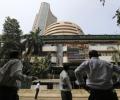
Top gainers in the Sensex pack included IndusInd Bank, ITC, L&T, M&M, PowerGrid, Asian Paints and SBI, ending up to 3.79 per cent higher.

On the price front, Indian manufacturing companies continued to face higher input costs during August.
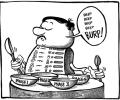
However, predictions that economic conditions will normalise after the elections underpinned optimism regarding the outlook and supported a stronger upturn in employment.

ICICI Bank was the top laggard in the Sensex pack, sinking over 10 per cent, followed by Bajaj Finance, HDFC, IndusInd Bank, Axis Bank and Maruti. Bharti Airtel and Sun Pharma were the gainers in the BSE index. NSE Nifty suffered a heavy loss of 566.40 points, or 5.74 per cent, to settle at 9,293.50.

Recently, Suzuki Motor Corp (SMC) in an investor presentation expressed strong intent to enter the electric vehicle (EV) space. This is part of a larger strategy the Hamamatsu-based firm has drawn up in developing electrification of technologies as it seeks to achieve carbon neutrality. The significance of this presentation is that it marked the first time that the Japanese carmaker spelt out its EV strategy with well-defined timelines. SMC plans to develop electrification technologies by 2025, fully implement them in products from the same year, and make a full-scale quantitative increase from 2030.
The headline seasonally adjusted Nikkei India Composite PMI Output Index, that maps both the manufacturing and services sectors, rose from 53.3 in June to 54.1 in July.

The Canadian smartphone maker is banking on its platform-agnostic security and software products to make incursions in the market.

On the job front, Indian service providers continued to add to their payrolls and the sector witnessed the second-strongest increase in employment since March 2011.

The models from Hyundai and Maruti, which might go on sale in October 2018 and February 2019, respectively, are set to revive a segment that had lost sheen to the compact SUV segment, lately

This is the 14th consecutive month that the manufacturing PMI remained above the 50-point mark. In PMI parlance, a print above 50 means expansion, while a score below that denotes contraction.

The testing facility at Rohtak would have more than 30 different tracks covering a length of about 30 km to check the various operational aspects of a vehicle.
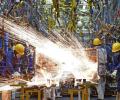
This is the ninth consecutive month that the manufacturing PMI remained above the 50-point-mark.
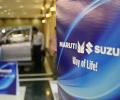
Maruti is not an online outlier, of course; other heavyweights have rolled out similar services. But as an analyst pointed out, Maruti's all-India roll-out has significant impact given that it accounts for over half of all cars sold, reports, reports Pavan Lall.
Business confidence remained positive in August and was driven by upbeat forecasts of sales, an expected improvement in demand and promotional activities

American refiners closed some of their production, leading to futures trade benchmarked to the West Texas Intermediate going negative.

Making a debut in India with an SUV, Citroen's products in the next couple of years will clearly chart and define its destiny in what has become both a vibrant but also a daunting market for foreign entrants, says Pavan Lall.

In a significant judgement, the Supreme Court has ruled that only the income earned by foreign firms from their operations in India was taxable and no tax can be levied on work done outside the country.

Forex traders said a stronger dollar also dragged the rupee down.

The entire range of Hyundai's diesel cars - from compact ones to SUV models, including the soon-to-be-launched Aura - will be eco-friendly.

India wasn't applying widespread crash testing like foreign countries do, so manufacturers didn't see the need for an investment focus on safety. Customers rarely walked into showrooms asking for the safest car. They wanted the cheapest or the most fuel-efficient or the best-looking car.
While manufacturing firms cut jobs for the first time in 20 months to sharply reduce costs, services providers continued their hiring spree.

A summary of sports events and sports persons, who made news on Thursday
The Nikkei Markit India Manufacturing Purchasing Managers' Index (PMI) -- an indicator of manufacturing activity -- fell to 49.6, down from 52.3 in November, coming below the crucial 50 threshold which separates contraction from expansion.

For Hero MotoCorp, India's largest two-wheeler company, it's a calculated gambit to revive Harley-Davidson whose ride in India has been anything but easy since it got here.When automotive firms embark on alliances, it's a roll of the dice on how such marriages will play out.

Top losers in the Sensex pack included ICICI Bank, Tata Steel, Vedanta, HDFC IndusInd Bank, Tata Motors, RIL and ONGC -- falling up to 4.45 per cent.

Chinese automakers Great Wall Motors, FAW Haima Automobile, and Changan Automobile, after dithering about entering India for some years, have been encouraged by the robust sales performance of the late entrants Kia Motors and MG Motors even in a slowing market.

Automakers are caught in a chicken-and-egg situation: Prices have to come down if volumes are to increase, and volumes won't increase unless prices come down, notes Pavan Lall.

Both the countries have increased prices of gas recently.

Poor contract workers often have little or no access to safety equipment or health benefits in factories.

Car makers are trying hard to boost sales in India.

The Nikkei India Manufacturing Purchasing Managers' Index (PMI) stood at 47.9 in July, down from 50.9 in June, its lowest mark since February 2009, and highlighted the first deterioration in business conditions in 2017 so far.

Other major laggards were IndusInd Bank, SBI, Bharti Airtel, ONGC, Tata Steel and Reliance Industries -- falling as much as 6.30 per cent.

Some cars that are emblematic of India's automobile industry will no longer come off the assembly lines after this year.
The Nikkei Markit India Manufacturing Purchasing Managers' Index (PMI) -- a gauge of manufacturing performance -- fell to 52.3, down from October's 22-month high of 54.4.

The Nikkei India Services Purchasing Managers' Index (PMI), which tracks services sector firms on a monthly basis, stood at 48.7 in January, as against 46.8 in December 2016.
On the other hand, jobs increased for the 10th straight month in the manufacturing sector, albeit only slightly

The survey noted that advertising campaigns supported the increase in new work growth in the sector amid competitive pressures.
 © 2026 Rediff.com - Advertise with us - Disclaimer - Privacy Policy - Sitemap - Feedback - About us - Terms of use - Grievances